The Laughing Goat Tavern
The Ballad of the Last DragonThe Laughing Goat Tavern is a lively establishment in Bucklebrook where fellowship, commerce, performance, and memory intersect. Its importance lies less in its function as a drinking house than in the way it gathers the traveling party, local workers, and future audiences into one room: here, Jaromir, Neith, Cadoc, and Sylvaine Abelan share uneasy companionship, Sylvaine begins converting Aeron Fowler’s deeds into a public legend, and the tavern’s staff become potential custodians of that story.
Setting and Appearance
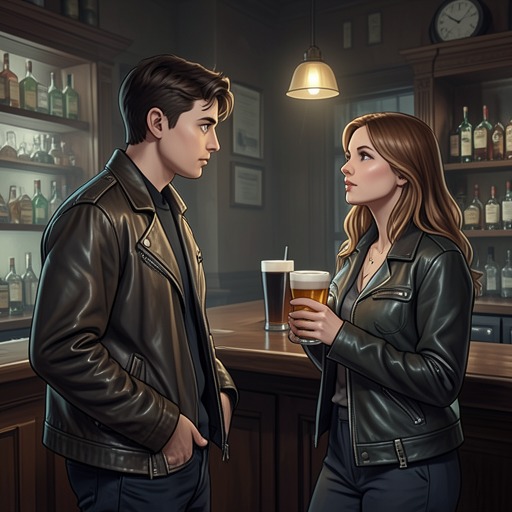
The party arrives in Bucklebrook in the evening and claims a table at The Laughing Goat Tavern, settling into a game of Sinners and Saints. The room is boisterous, full of conversation and laughter, and organized around a bar where ale is served while patrons occupy tables nearby. The tavern is not an anonymous inn interior. Heavy posts and beams are etched with goats in varied poses, and a row of dark-green clay tankards painted against goat silhouettes hangs above the bar. These deliberate decorations give the building an eccentric, almost playful identity, turning its structure and equipment into signs of communal taste.
The goat imagery also makes the tavern a space of open, bodily conviviality rather than quiet refinement. Its carved beams, crowded tables, drinking vessels, and loud patrons create an environment where private feeling is continually exposed to public life. The same atmosphere can be welcoming and overwhelming: Sylvaine is still physically tense after being jostled in the crowd, yet the tavern’s noise and familiar social pattern eventually allow the company to resume its shared routines.
Staff and Social Economy
The tavern’s front-facing barkeep is a young, stocky man with thick shoulders, warm bronze skin, messy auburn hair, and green eyes. Sylvaine initially notices him only in passing, but a gesture as simple as wiping the bar and throwing the towel back over his shoulder recalls Kingsley and unsettles her with homesickness. The resemblance gives the tavern an unexpected emotional function: it becomes a place where the present journey repeatedly opens onto the remembered safety of The Rusty Nail.
The barkeep is identified as being of possible dwarven descent, a detail that Sylvaine reads against the region’s history of ethnic hierarchy. She observes that a dwarven barkeep can move through the room with an easy air of camaraderie, whereas an elven barkeep might face tension and hostility from drunken patrons. The tavern therefore embodies a social order shaped by the aftermath of The Unification, when human and dwarven histories were preserved as heroic accounts while elven texts and sacred structures were destroyed. Its ordinary sociability is not politically neutral; it rests within a culture where belonging is distributed unequally.
Tomas handles most of the tavern’s practical work even though his uncle owns the establishment. He rises before sunrise to keep it stocked and accounted for, and he has been promised the deed when his uncle dies, or possibly earlier. His competence is shown through mundane labor, including firing a serving girl after catching her sneezing into a hunter’s pot and taking responsibility for the resulting shortage of staff. The tavern’s future ownership thus appears connected to diligence rather than mere inheritance, while Tomas’s work also makes him a possible carrier of the stories performed there.
The Tavern as Refuge and Memory
The Laughing Goat Tavern recalls the sanctuary Sylvaine found after fleeing Birchfield. At the Red Wyvern Tavern, its owner had tried to bargain food for sexual access while she scavenged half-eaten scraps from dirty plates. She escaped without planning, carrying only her lute, a few coins earned from performing, and the cap that concealed her ears. Days later, barely able to stand, she reached The Rusty Nail, persuaded Kingsley to let her sing, and was given food by Brigitta for the Winter Solstice celebration. Sylvaine later understands that Kingsley and Brigitta had been looking after her.
That history makes The Laughing Goat more than a temporary stop. Its crowded room offers a version of the protection Sylvaine associates with Hollowden, even as the tavern’s public bustle keeps her alert and anxious. Jaromir’s presence reinforces this refuge: after an evening of intimacy, he helps her return to her room by climbing the outer walls and even lets her stand on his shoulders. The building’s walls consequently serve both as architecture and as a route through which care is enacted, allowing the pair to evade the crowded tavern without severing their connection to it.
The horse Chessa is also tied to the tavern’s economy of departure and loss. The man sitting nearby is the one who purchased Jaromir’s injured horse at a steep discount. Cadoc had treated the wound and believed Chessa would live, but the party could not take her on the journey. Jaromir’s whispered goodbye, which is how Sylvaine learns the horse’s name, places a private farewell inside the tavern’s ordinary commercial setting. The room holds drinking, card play, and trade alongside the quiet acknowledgment that travel requires leaving living attachments behind.
Performance and the Making of Legend
The tavern becomes a deliberate stage for Sylvaine’s campaign to spread Aeron Fowler’s heroic ballad. On a later full-house evening, she tunes her lute while Jaromir sits beneath a goat-adorned beam, Neith leans against a support post with her tankard, and Cadoc remains at the bar speaking with Tomas. Sylvaine positions each member of the group so that the tavern’s audience will not merely hear the song but observe its apparent communal endorsement. She knows that once word spreads, the ballad can begin speaking for itself, although she still believes visible assistance will help it take root.
Her first attempt is nearly swallowed by the room’s noise. The initial plucking does not carry over dozens of conversations and bursts of laughter, and Jaromir recognizes the problem. The moment reveals that artistic authority in the tavern is not granted automatically; the performer must seize attention from drinkers whose immediate pleasures compete with the song. Sylvaine’s response is not withdrawal but adaptation. When the performance reaches the end of its first part, she has told how Aeron vanquished monstrous beetles and, with the help of his loyal crew, destroyed the entire nest.
The physical cost of the performance confirms its seriousness. Sweat runs into Sylvaine’s eyes, her fingers ache from new calluses, and her neck burns, yet playing feels deeply satisfying because she can enter the role of storyteller. The tavern’s response then converts private labor into public memory: Jaromir applauds with warmth, Neith receives raised tankards from a table of soot-marked miners and drinks one herself, and Cadoc claps Tomas on the back while Tomas returns his attention. The room becomes a network of witnesses, with each reaction helping establish Aeron’s deeds as material worthy of repetition.
Narrative Significance
The Laughing Goat Tavern is a threshold between passing through and belonging. Travelers arrive there to drink, gamble, conduct business, and recover from the road, but the tavern also determines what survives beyond the immediate company. Tomas’s possible future ownership gives the establishment continuity, while Sylvaine’s performance supplies it with a narrative that can circulate among later patrons. The tavern is therefore both an economic institution and an archive in motion.
Its conviviality also exposes the contradictions of the wider world. The room welcomes a mixed group of humans and a possible dwarf, yet Sylvaine’s reflections make clear that an elf would not necessarily receive the same easy acceptance. Within this compromised social space, she nevertheless uses music to contest erasure. The Laughing Goat’s carved goats, crowded tables, working bar, and attentive witnesses become the setting in which a dead companion’s deeds are transformed into a living story. Its decisive role is to show how refuge and prejudice, pleasure and grief, commerce and art can occupy the same public room.